

In a world where sustainability is no longer optional, the Go Sustainable Tourism (GST) certification provides tourism stay establishments with more than just a stamp of approval: it offers a verifiable method to manage their establishment for sustainability.
Founded and developed under the leadership of Dr. Niël du Toit, GST is the result of many years of intensive academic and industry research, designed to position sustainable tourism businesses with a genuine competitive edge in an increasingly discerning marketplace. As dr du Toit remarks:
“Informal talks show that individuals and small groups prefer places that are certified. A persisting problem is that there are various certifications making the trustworthy choice difficult.”
Why Sustainability Matters Now More Than Ever

A powerful movement of sustainable tourism is driving a new breed of conscious travellers. This means eco tourists actively seek more thoughtful decisions about transport, accommodation and how they support local communities, respecting the cultural and ecological heritage of the local areas they visit.
As Emeritus Professor Leon Hugo (former head of the Department of Geography at Pretoria University) warns:
“The current trajectory of exploiting natural ecosystems to meet our escalating demands for energy, food, and material possessions is unsustainable. Without a shift towards sustainable practices, the prevailing trend of pursuing more for all will lead to a downward spiral, where progress will finally halt due to ecosystem collapse.”
This focus results in modern travellers being more conscious than ever about where they stay and how their choices affect the planet. They seek authentic, transparent sustainability, not marketing gimmicks or “greenwashed” promises. The result for accommodation providers is a fundamental shift, creating both a challenge and an opportunity: to demonstrate that their operations truly benefit people, places and the planet.
Tourists Do Care
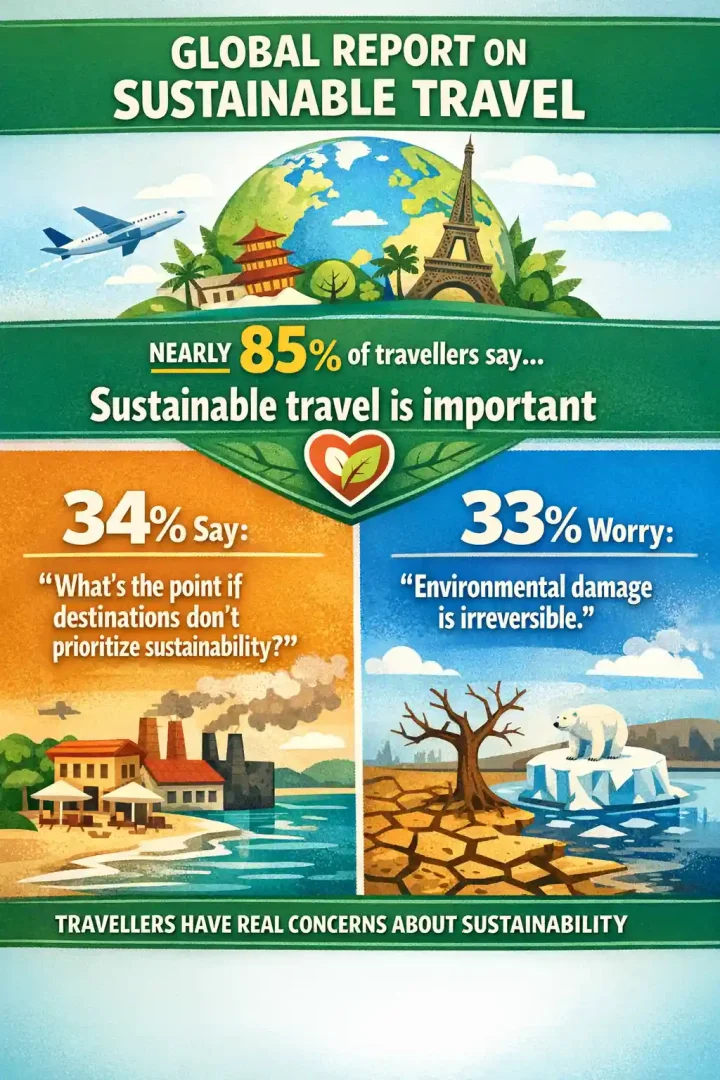
According to a global report, while close to 85% of travellers say that sustainable travel is important, 34% believe their efforts are pointless if destinations don’t prioritise sustainability, and 33% worry that environmental damage is irreversible.
This paradox paints a clear picture: while travellers do care deeply, they are done with lip service. Conbsequently, they want truth and transparency before they commit to travelling with purpose.
With scrutiny rising, trust becomes everything. Therefore, tired of greenwashing and vague claims, travellers want evidence.
GST bridges this gap by guiding tourism stay businesses through a rigorous, statistically-based certification process that verifies genuine owner-managed standards, not superficial compliance.
The GST Framework: Four Interdependent Pillars
At the heart of GST’s approach are four interdependent pillars that form a holistic framework for managing a tourism stay business:
- Company – Embedding sustainability into the core business strategy, management systems and operations to ensure long-term resilience, profitability and ethical integrity.
- Customer – Building trust and loyalty by delivering authentic, transparent sustainability commitments that resonate with conscious travellers.
- Community – Supporting local economies, empowering people and respecting cultural heritage to ensure that tourism uplifts rather than exploits.
- Conservation – Protecting and enhancing natural ecosystems and cultural heritage resources. In this way tourism contributes to environmental biodiversity stewardship and long-term cultural resilience.
As a result, these pillars work together to transform sustainability from a compliance exercise into a strategic advantage, ensuring that every certified establishment benefits economically, socially and environmentally.
Why is GST is different?

Go Sustainable Tourism (GST) provides a data-driven certification process that goes beyond marketing labels.
Unlike vague self-reporting schemes or one-off audits, the GST approach focuses on measurable outcomes and continuous improvement. Thus enabling businesses to move past superficial compliance and show would-be guests real sustainable tourism progress. Businesses are guided through practical steps, and supported to achieve meaningful progress:
- Evidence-Based: Every certification is grounded in measurable data and performance outcomes.
- Expert Assessment: Each participating establishment is evaluated and guided by trained GST Assessors, ensuring that certification is accurate, meaningful and achievable.
- Continuous Improvement: GST promotes ongoing progress, not a one-time approval.
- Market Recognition: With its research-based verification, GST-certified establishments stand out as trustworthy and authentic in the marketplace. Where others offer labels, GST delivers legitimacy.
A Competitive Edge in a Crowded Market
For accommodation providers, GST certification is more than a sustainability badge, it’s a strategic business investment. Certified businesses gain:
– Enhanced brand credibility among eco-conscious travellers and tour operators.
– Operational efficiency and cost savings through improved resource management.
– Stronger community relationships with local stakeholders.
– Increased market access as future sustainable travel continues to shape booking decisions and partnerships.
With the depth of research, credibility and ongoing guidance behind GST, your establishment won’t just be claiming to be sustainable, it will be proving it is ahead of the curve.
Join the Movement Towards Authentic Sustainability
Go Sustainable Tourism empowers you to operate responsibly, stand out authentically and contribute meaningfully to a sustainable future for tourism.
True sustainability is not about saying you care, it’s about proving you do.
Adapted from an article by Mark van Eyssen
Go Sustainable Tourism